We love the surge. That eagerly anticipated, intensely orchestrated burst of energy and strength that drives horses around ten furlongs of dirt and dust in two minutes or less (if you count Secretariat) provides a contagious drama that draws spectators and speculators from around the world. Perhaps thoroughbreds embody what all of us desire: the capacity to perform at extremely high levels at critical times. LeBron James explodes past defenders in singleminded pursuit of the rim. Adrian Peterson sheds tacklers who dare stand between him and the end zone. Ryan Howard slams a fast ball 500 feet over the center field wall. Davis Love III crushes a drive 450 yards down the middle of the fairway. It's not just fun to watch, it stirs our spirits, reminding us of our own passion for excellence, instructing us in the power of drive and determination.
But that beloved burst of epinephrine (adrenaline) that fuels our peak performances is the same hormonal phenomenon that feeds our propensity to panic. Necessary when confronted with real and present dangers, essential for effective fight or flight, the heightened state of alertness and anxiety that is so helpful in small doses can be dangerous -- even devastating -- with prolonged exposure. Politicians who shrewdly capitalize on the opportunities implicit in crisis understand this well: panic produces a level of energy and attention not otherwise available, and there are certain short-term advantages to stirring up a well-timed crisis. Business leaders get it too: a good crisis helps generate the funding and resources required to implement significant change. We thrive on crisis (and the panic it provides) in nearly every aspect of living. Our lives sometimes resemble an endless series of emergencies, our homes and workplaces imitate immediate care centers, and triage becomes our standard operating procedure. But eventually, inescapably, the energy wanes, the alertness fades, burnout sets in, and further efforts to stir and awaken are met with increasingly persistent apathy and lethargy. And we wonder why.
The solution to this silly pattern is not at all complicated or complex. We all know that a marathon is run at a different pace than a sprint, that 500-mile races require pit stops, that starting pitchers need three or four days rest between starts, and that every sport has an off-season. We need breaks, naps, weekends, vacations. We need rest, relaxation, recreation, recuperation. The crazy thing is, I'm not sure how long a horse would run, if the jockey didn't tell him to stop. I'm not sure LeBron would ever take himself out of the game, if the coach didn't send in a sub. A dog bred for hunting, but not yet trained to stop when he hears the horn blow, will indeed run himself to death, if the fox is too fast and the chase too long.
We all need a jockey, a coach, a manager, a trainer: someone to blow the horn when its time to stop chasing. Some people picture God as the chronically dissatisfied boss who always wants more out of us: do more, love more, serve more, sacrifice more. Thankfully, the ancient wisdom of scripture preserves a different picture. Our Creator and Redeemer is the Lord of the Sabbath, the Lord of Rest, the Almighty Horn-Blower. When He tells you to stop, Stop.
My soul finds rest in God alone; my salvation comes from him. -- Psalm 62:1
Shalom.
-- Brother Tom
Saturday, May 2, 2009


Saturday, April 18, 2009
Anger Before Sundown
Yesterday I woke up angry.
It didn't have anything to do with taxes or tea parties, although I certainly sense deep discouragement regarding the fiscal responsibility of central governments, along with a cautiously cynical sympathy with populist protesters.
It didn't have anything to do with vocational frustration, although events of recent weeks and months have tortured (at least harshly interrogated) my tenuous grasp on occupational risk and reward.
It didn't have anything to do with church or family, although the complex and intertwined dynamics of both offer abundant cause for befuddlement and bewilderment.
Apparently, I was angry at the calendar. It took me several hours to arrive at that conclusion, but once my gaze happened upon the current date, my previously unfocused orneriness crystalized upon its target: April 17. The sixth occurrence of the julian month and date that ended the days (at least the finite ones) of my best friend's life.
People talk about living each day as if it were your last day. I remember the day that was Chuck's last day. I did not like that day. I still do not like that day. I do not desire to live another day in any way like that day. I don't even like to remember that day. But I do remember it, and I always will.
I remembered that day yesterday, with anger. When Job was blessed with the shade of a gourd, he grew angry when that gourd was taken away. I too am angered when the persons and things that bring me great joy and comfort are then taken away. I am not speaking of sadness, or longing, or even the emptiness that persists where fellowship was once felt. I speak of anger, of indignation at the specific injustice, of railing and ranting rejection of the not-rightness, of defiant denouncement of the royal decree.
The calendar, like the gourd, is but a parabolic receiver which gathers and focuses the waves of anger onto a single point, where it can be more clearly perceived, and perhaps somewhat more clearly understood. I was not really angry at the calendar, but through the calendar I was able to project my anger at Chuck. For leaving. For taking away all the goodness that we enjoyed together. To project a bit further than my heart can perceive, I was probably not angry at Chuck either. Through Chuck, I have projected anger directed at God. The Creator of time and fellowship and every other good and blessed thing is the One to be blamed when they are taken away. The Lord giveth and the Lord taketh away.
That was yesterday morning.
Yesterday afternoon, I played golf with a friend, on a beautiful golf course, on a beautiful day. The friend had called the day before, unexpectedly, on the off chance that we might both have the same day off work. By some strange coincidence, we both did. My friend reminds me a bit of Chuck, partly because of his girth (Chuck was larger than life in more ways than one), but more because of his mirth, and mostly because he is, well, a good friend. Also unexpectedly, my friend brought along another friend, who had called him out of the blue with the same purpose in mind. By another strange coincidence, that friend's name was Chuck. None of us played particularly well, but that did not matter much. It was a very good afternoon.
Yesterday evening, by another odd and expected intersection of circumstances, I learned that Chuck's widow, Carol, and their daughter, Cami, were traveling south, and stopping for dinner in Elizabethtown, about a half hour away. I learned this just as my wife got home from a day of errand running, wondering what me might do for dinner. It wasn't hard to perceive the serendipity of the moment, and we sped (my wife was driving) to a brief but wonderful time of fellowship and solace shared. It was a very good evening.
By the time the sun went down, my anger had subsided.
Not destroyed, simply diminished.
Returned to its proper place in time.
It may seem a trivial point, but somewhere on the 17th fairway it dawned on me. Chuck was not a man of great means (though he was by all means great), and what he left behind was mostly of the intangible, eternal sort. The one tangible thing I own that once belonged to him is the set of golf clubs I played with yesterday.
I will never replace those clubs.
I will never replace Chuck.
I will never need to.
The Lord giveth and the Lord taketh away.
Blessed be the name of the Lord.
-- Brother Tom
It didn't have anything to do with taxes or tea parties, although I certainly sense deep discouragement regarding the fiscal responsibility of central governments, along with a cautiously cynical sympathy with populist protesters.
It didn't have anything to do with vocational frustration, although events of recent weeks and months have tortured (at least harshly interrogated) my tenuous grasp on occupational risk and reward.
It didn't have anything to do with church or family, although the complex and intertwined dynamics of both offer abundant cause for befuddlement and bewilderment.
Apparently, I was angry at the calendar. It took me several hours to arrive at that conclusion, but once my gaze happened upon the current date, my previously unfocused orneriness crystalized upon its target: April 17. The sixth occurrence of the julian month and date that ended the days (at least the finite ones) of my best friend's life.
People talk about living each day as if it were your last day. I remember the day that was Chuck's last day. I did not like that day. I still do not like that day. I do not desire to live another day in any way like that day. I don't even like to remember that day. But I do remember it, and I always will.
I remembered that day yesterday, with anger. When Job was blessed with the shade of a gourd, he grew angry when that gourd was taken away. I too am angered when the persons and things that bring me great joy and comfort are then taken away. I am not speaking of sadness, or longing, or even the emptiness that persists where fellowship was once felt. I speak of anger, of indignation at the specific injustice, of railing and ranting rejection of the not-rightness, of defiant denouncement of the royal decree.
The calendar, like the gourd, is but a parabolic receiver which gathers and focuses the waves of anger onto a single point, where it can be more clearly perceived, and perhaps somewhat more clearly understood. I was not really angry at the calendar, but through the calendar I was able to project my anger at Chuck. For leaving. For taking away all the goodness that we enjoyed together. To project a bit further than my heart can perceive, I was probably not angry at Chuck either. Through Chuck, I have projected anger directed at God. The Creator of time and fellowship and every other good and blessed thing is the One to be blamed when they are taken away. The Lord giveth and the Lord taketh away.
That was yesterday morning.
Yesterday afternoon, I played golf with a friend, on a beautiful golf course, on a beautiful day. The friend had called the day before, unexpectedly, on the off chance that we might both have the same day off work. By some strange coincidence, we both did. My friend reminds me a bit of Chuck, partly because of his girth (Chuck was larger than life in more ways than one), but more because of his mirth, and mostly because he is, well, a good friend. Also unexpectedly, my friend brought along another friend, who had called him out of the blue with the same purpose in mind. By another strange coincidence, that friend's name was Chuck. None of us played particularly well, but that did not matter much. It was a very good afternoon.
Yesterday evening, by another odd and expected intersection of circumstances, I learned that Chuck's widow, Carol, and their daughter, Cami, were traveling south, and stopping for dinner in Elizabethtown, about a half hour away. I learned this just as my wife got home from a day of errand running, wondering what me might do for dinner. It wasn't hard to perceive the serendipity of the moment, and we sped (my wife was driving) to a brief but wonderful time of fellowship and solace shared. It was a very good evening.
By the time the sun went down, my anger had subsided.
Not destroyed, simply diminished.
Returned to its proper place in time.
It may seem a trivial point, but somewhere on the 17th fairway it dawned on me. Chuck was not a man of great means (though he was by all means great), and what he left behind was mostly of the intangible, eternal sort. The one tangible thing I own that once belonged to him is the set of golf clubs I played with yesterday.
I will never replace those clubs.
I will never replace Chuck.
I will never need to.
The Lord giveth and the Lord taketh away.
Blessed be the name of the Lord.
-- Brother Tom
Saturday, April 11, 2009
Directory Assistance
411
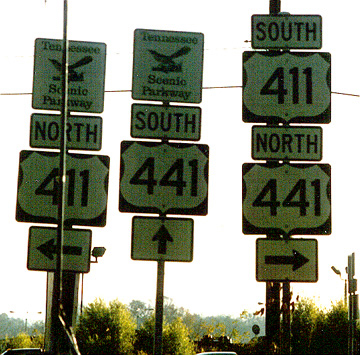
I'm a numbers guy, a math major. Numerical patterns catch my eye, whether buried deep in financial records or posted publicly on street signs. ( Here's my favortie highway sign, at the "big light" in Sevierville, where US 411 and US 441 conspire to confound the directionally challenged.) Today it's the calendar that carries a digital association: 4/11 is the date, and 411 is also the most frequently dialed number on my Blackberry (owing perhaps to my chronic need for verbal direction to compensate for my lack of prior planning). In a nutshell, 411 is the number you need when you need somebody's number.
In ancient cultures, knowing a person's name implied a certain amount of power over them. The modern equivalent is knowing their number. Having transitioned slowly from land line to cell phone, I have noticed that those who know me well call me on my cell, while the old "home phone" number is apparently reserved for strangers, solicitors, and those whose list-keeping deficiencies left them dependent on the obsolescent phone book. Thus conditioned and biased, I typically answer my cell, while I let "the machine" answer the home's phone.
I'm not aware of any 411 or "directory assistance" service that shares cell phone numbers, nor do I know of any "phone book" that publishes them. This may be a temporary, transitional condition. Or it may reveal something about the reconstruction of our culture. In many ways, the "phone book" has been superseded by Facebook, who announced this week their 200 millionth "face" (member). Along with it's sister social-networking sites, Facebook has engineered an interesting and revealing balance between publicity and privacy, facilitating the finding of long-lost friends and associates, while retaining an "invitation-only" restriction for more closely-held information.
Which raises an interesting question: how much do you want to be known? With specious simplicity, this inescapable question operates at three distinct levels:
First, how deep is your desire to be known? Do you long to be understood and appreciated, or are you more content with behind-the-scenes, under-the-radar anonymity?
Second, how widely do you want to be known? Do you find satisfaction in a large number of friends (and perhaps admirers), or do you prefer the sanctity of a smaller "inner circle"?
Third, how well do you want to be known? Do you seek opportunity to express the secrets of your soul in revealing and transparent authenticity, or do you lean toward concealing the private and personal aspects of your life?
I have heard it said that we can never know more about another person than we are willing to reveal about ourselves. It rings true, and delivers quite a dilemma to the closet introverts among us: either we lower our shields and allow others (at least a few) to know us as we truly are, or we effectively banish ourselves from intimacy and fellowship with those we would truly like to know. Reveal too much, and we risk rejection and ridicule for faults we have not overcome, or for uniqueness not commonly embraced. Conceal too much, and we concede isolation from society and disconnectedness from needed community. It is, if you will, a delicate dance of veils.
To paraphrase St. Francis,
May God grant you the courage to reveal what is authentic,
The grace to conceal what is intimate,
And the wisdom to know the difference.
I'm a numbers guy, a math major. Numerical patterns catch my eye, whether buried deep in financial records or posted publicly on street signs. ( Here's my favortie highway sign, at the "big light" in Sevierville, where US 411 and US 441 conspire to confound the directionally challenged.) Today it's the calendar that carries a digital association: 4/11 is the date, and 411 is also the most frequently dialed number on my Blackberry (owing perhaps to my chronic need for verbal direction to compensate for my lack of prior planning). In a nutshell, 411 is the number you need when you need somebody's number.
In ancient cultures, knowing a person's name implied a certain amount of power over them. The modern equivalent is knowing their number. Having transitioned slowly from land line to cell phone, I have noticed that those who know me well call me on my cell, while the old "home phone" number is apparently reserved for strangers, solicitors, and those whose list-keeping deficiencies left them dependent on the obsolescent phone book. Thus conditioned and biased, I typically answer my cell, while I let "the machine" answer the home's phone.
I'm not aware of any 411 or "directory assistance" service that shares cell phone numbers, nor do I know of any "phone book" that publishes them. This may be a temporary, transitional condition. Or it may reveal something about the reconstruction of our culture. In many ways, the "phone book" has been superseded by Facebook, who announced this week their 200 millionth "face" (member). Along with it's sister social-networking sites, Facebook has engineered an interesting and revealing balance between publicity and privacy, facilitating the finding of long-lost friends and associates, while retaining an "invitation-only" restriction for more closely-held information.
Which raises an interesting question: how much do you want to be known? With specious simplicity, this inescapable question operates at three distinct levels:
First, how deep is your desire to be known? Do you long to be understood and appreciated, or are you more content with behind-the-scenes, under-the-radar anonymity?
Second, how widely do you want to be known? Do you find satisfaction in a large number of friends (and perhaps admirers), or do you prefer the sanctity of a smaller "inner circle"?
Third, how well do you want to be known? Do you seek opportunity to express the secrets of your soul in revealing and transparent authenticity, or do you lean toward concealing the private and personal aspects of your life?
I have heard it said that we can never know more about another person than we are willing to reveal about ourselves. It rings true, and delivers quite a dilemma to the closet introverts among us: either we lower our shields and allow others (at least a few) to know us as we truly are, or we effectively banish ourselves from intimacy and fellowship with those we would truly like to know. Reveal too much, and we risk rejection and ridicule for faults we have not overcome, or for uniqueness not commonly embraced. Conceal too much, and we concede isolation from society and disconnectedness from needed community. It is, if you will, a delicate dance of veils.
To paraphrase St. Francis,
May God grant you the courage to reveal what is authentic,
The grace to conceal what is intimate,
And the wisdom to know the difference.
Now we see but a poor reflection
As in a mirror;
Then we shall see face to face.
Now I know in part;
Then I shall know fully,
Even as I am fully known.
-- I Corinthians 13:12
Saturday, April 4, 2009
Longing and Pursuit
Our oldest son was about three or four years old when he first made the connection between a strange discomfort in his tummy and the fact that he hadn't eaten in a while. Recognizing and naming that discomfort as "hunger" was a surprisingly significant step toward autonomy, for it focused a primal linkage between cause and effect, behavior and consequence, desire and decision. From that point on, eating had a purpose beyond compliance with parental meal schedules; it was now understood that food was required by the self, not just by the rules. The first footer had been poured for the foundation of his personal "hierarchy of needs".
Granted, babies are born with an instinct to eat when they are hungry and sleep when they are tired, but both instincts are experienced in discomfort and expressed in anxious crying. By the time the awareness of unmet needs and unfulfilled desires enters the conscious mind, many patterns have already been established. The world has proven to be either trustworthy or not in its attentiveness to our cries, and we have learned various effective and ineffective techniques for getting what we want, and for dealing with disappointment when we don't.
Simplistic extrapolation suggests a continuous dynamic of discerning the nature of our desires, and experimenting with various means which may or may not satisfy them. A fundamental observation worth remembering is that we do not always know what we want. The humble admission that we fail to understand fully the needs of our own bodies -- let alone our hearts and minds -- is an oft-neglected prerequisite in the shared search for fulfillment.
But that is not to say that self-understanding must be sufficiently achieved before satisfaction can be found. Quite the contrary: those who insist on first figuring out exactly what they are looking for frequently doom themselves to a perpetual editing of specifications and requirements. They become too easily quagmired in contemplation and analysis, and are prone to underestimate potential and bypass opportunities, due to chronic hesitation and resistance to commitment.
It is rather the humility of limited self-understanding that opens a window to potential fulfillment, and to the wise pursuit thereof. For it is neither by deductive reasoning nor deterministic selection that we find the sources of satisfaction. Instead, it is through an inductive adventure of approximate solutions, an iterative model of rapid and imperfect prototyping, that we gradually narrow the gap between desired and achieved, between ideal and real, between sought and found, between asked and received.
Trouble is found when this noble pursuit is side-tracked by the seductive appeal of short-cuts. Advance to GO, and collect $200 -- that's the card we want to draw, and we hope to draw it now. Dispense with the journey and transport me to the destination. Satisfy and gratify me in six easy steps, or with one small pill. Every successful advertiser understands the power of unmet needs and unsatisfied desire. Intentional deception is standard practice when tapping in to this motivational core. Convince a man that you can satisfy his deepest desire, and he will offer you his very soul.
I am not immune from this deception. "There's got to be an easier way" is a phrase frequently repeated in my frustrated mind. Energized by effort, alert with adrenaline, quickened by caffeine, I find the urgent pursuit -- of answers for questions, solutions for problems, and resources for demands -- absolutely addictive. Worst of all, the addiction grows with each perceived success. When I start to believe that every question can be answered, that every problem can be solved, and that every demand can be met -- when I believe that success and satisfaction are simply the result of effort, energy, and resolve -- then I am most deeply deceived and most desperately off track.
From the depths of this recurring addiction, I have learned of only one therapy worth recommending. But first, I'll briefly mention two that are to be avoided. First, do not attempt to suppress desire. While restraint is a virtue, and the ability to redirect passion a priceless skill, the indiscriminate attempt to eradicate appetite is a deeply misguided mistake, and simply increases the likelihood of a violent and explosive backlash. Second, do not indulge desire. Eat when you're hungry and sleep when you're tired, but do not trust your every whim and longing to guide your every action. Passions must by purified, and impulses must be checked, else you will find yourself enslaved to a most fickle and unfaithful master.
One thing I have found helpful in this haunted pursuit; one focal point yields the necessary perspective. I recommend this one truth from my heart to yours, whenever the discomfort of dissatisfaction troubles your soul:
-- Brother Tom
Granted, babies are born with an instinct to eat when they are hungry and sleep when they are tired, but both instincts are experienced in discomfort and expressed in anxious crying. By the time the awareness of unmet needs and unfulfilled desires enters the conscious mind, many patterns have already been established. The world has proven to be either trustworthy or not in its attentiveness to our cries, and we have learned various effective and ineffective techniques for getting what we want, and for dealing with disappointment when we don't.
Simplistic extrapolation suggests a continuous dynamic of discerning the nature of our desires, and experimenting with various means which may or may not satisfy them. A fundamental observation worth remembering is that we do not always know what we want. The humble admission that we fail to understand fully the needs of our own bodies -- let alone our hearts and minds -- is an oft-neglected prerequisite in the shared search for fulfillment.
But that is not to say that self-understanding must be sufficiently achieved before satisfaction can be found. Quite the contrary: those who insist on first figuring out exactly what they are looking for frequently doom themselves to a perpetual editing of specifications and requirements. They become too easily quagmired in contemplation and analysis, and are prone to underestimate potential and bypass opportunities, due to chronic hesitation and resistance to commitment.
It is rather the humility of limited self-understanding that opens a window to potential fulfillment, and to the wise pursuit thereof. For it is neither by deductive reasoning nor deterministic selection that we find the sources of satisfaction. Instead, it is through an inductive adventure of approximate solutions, an iterative model of rapid and imperfect prototyping, that we gradually narrow the gap between desired and achieved, between ideal and real, between sought and found, between asked and received.
Trouble is found when this noble pursuit is side-tracked by the seductive appeal of short-cuts. Advance to GO, and collect $200 -- that's the card we want to draw, and we hope to draw it now. Dispense with the journey and transport me to the destination. Satisfy and gratify me in six easy steps, or with one small pill. Every successful advertiser understands the power of unmet needs and unsatisfied desire. Intentional deception is standard practice when tapping in to this motivational core. Convince a man that you can satisfy his deepest desire, and he will offer you his very soul.
I am not immune from this deception. "There's got to be an easier way" is a phrase frequently repeated in my frustrated mind. Energized by effort, alert with adrenaline, quickened by caffeine, I find the urgent pursuit -- of answers for questions, solutions for problems, and resources for demands -- absolutely addictive. Worst of all, the addiction grows with each perceived success. When I start to believe that every question can be answered, that every problem can be solved, and that every demand can be met -- when I believe that success and satisfaction are simply the result of effort, energy, and resolve -- then I am most deeply deceived and most desperately off track.
From the depths of this recurring addiction, I have learned of only one therapy worth recommending. But first, I'll briefly mention two that are to be avoided. First, do not attempt to suppress desire. While restraint is a virtue, and the ability to redirect passion a priceless skill, the indiscriminate attempt to eradicate appetite is a deeply misguided mistake, and simply increases the likelihood of a violent and explosive backlash. Second, do not indulge desire. Eat when you're hungry and sleep when you're tired, but do not trust your every whim and longing to guide your every action. Passions must by purified, and impulses must be checked, else you will find yourself enslaved to a most fickle and unfaithful master.
One thing I have found helpful in this haunted pursuit; one focal point yields the necessary perspective. I recommend this one truth from my heart to yours, whenever the discomfort of dissatisfaction troubles your soul:
The LORD is my shepherd, I shall not be in want.
He makes me lie down in green pastures,
he leads me beside quiet waters,
he restores my soul.
He guides me in paths of righteousness
for his name's sake.
Even though I walk
through the valley of the shadow of death,
I will fear no evil,
for you are with me;
your rod and your staff,
they comfort me.
You prepare a table before me
in the presence of my enemies.
You anoint my head with oil;
my cup overflows.
Surely goodness and love will follow me
all the days of my life,
and I will dwell in the house of the LORD
forever.
-- Brother Tom
Saturday, March 28, 2009
49.5
Normally, I would round up; but in this case, I just don't feel like it.
Forty-nine years and six months is not equal to fifty years. Mathematically, there is no doubt about that. Physically, emotionally, and psychologically, I'm going to be hard-pressed to maintain the distinction, but I simply don't want the things that are generally true of fifty-year-olds to be true of me. Not yet. If I can delay their arrival six more months, I will. But I fear it is already too late for that.
Aging is a continuous process, despite our best efforts to measure and report it in discrete intervals and groupings. One's "age group" has become a ubiquitous involuntary identifier, to which are attached numerous calculated presumptions, from preferred investment strategies and pharmaceutical aids to frequency of bathroom breaks and of certain uncomfortable medical examinations. We age one day, one moment, at a time, but we contemplate and appropriate age in bigger chunks -- at first years, then decades. The biological observation that we have ten fingers and ten toes seems anthropologically connected to the fact that birthdays with zeroes in them hit us harder that the ones that don't.
Okay, so I'm not ready to be "in my fifties" yet, and I am indulging in a bit of anticipatory obsession over the event. Ignoring the fact that my best friend died shortly after his fiftieth birthday (i guess it's obvious that I'm not actually ignoring it), there is something about being "almost done" with my forties that leaves me feeling, well, restless. I find myself remembering the ticking urgency of a timed test, when the number of remaining questions unanswered was disproportional to the remaining minutes available. But that's not quite the same feeling. This is more like putting down a good book, half-way through a pivotal chapter, pulled away by more pressing concerns, not sure when (or even if) the next opportunity to read will come. Or its like needing to leave the much-enjoyed company of a good but distant friend, because there is a plane to catch, with no clear idea whether this meeting will be followed by a next one. I understand the inaccuracies of these metaphors, the implicit deception in such weak analogies. I know that I will not be significantly less able to answer a question or finish a book or meet with an old friend six months from now than I am today; but I also understand finite mathematics: six months from now -- six moments from now -- I will have fewer remaining opportunities to do such things than I currently have.
The realization of diminishing opportunity (and capacity) is not new, not surprising, not even depressing (unless obsessed over). What is disconcerting, however, in an ironic sort of way, is that my desire for such opportunities seems to be moving in the opposite direction. There are more questions that I want to answer now than there were when I was twenty, partly because new questions have been asked, partly because I have new answers, but mostly because there are questions that interest me now that did not interest me before. There are more books that I want to read now than there were when I was thirty, partly because new ones have been written, partly because I have discovered old ones I didn't know about before, but mostly because my curiosity has grown, and I now want to read books I did not want to read before. There are more friends I want to spend time with now that there were when I was forty, partly because I have made new friends, partly because I have reconnected with old friends, but mostly because I value friendship more now than I did before.
Perhaps this points me to the ancient truth, that God "has set eternity in the hearts of men." (Ecclesiastes 3:11) It is simply true that my longing, my desire, my curiosity, and my thirst exceed the likely limitations of this mortal lifetime. Straight linear extrapolation persuades me that I shall not be fully satisfied with the opportunities and diminishing capacities of this finite life, but this is neither a concession to sadness, nor a resignation to disappointment. I fully intend to fully enjoy every opportunity that comes my way, to the limits of my capacity and beyond. My cup has been overflowing for some time now, and I fully expect that it shall continue to overflow, as my supersaturated spirit absorbs God's superabundant blessings. I also intend to seek the infinite within and among the finite. Just as there are an infinite number of real numbers between 1 and 2, so there are an infinite number of opportunities to live, love, and enjoy between this moment and the next, between today and tomorrow, between 49.5 and 50. I intend to seek them out and celebrate them, much as Katsumoto sought the perfect cherry blossom. ("A perfect blossom is a rare thing. You could spend your life looking for one. And it would not be a wasted life." -- from The Last Samurai)
But I know without doubt that my search shall always surpass my discovery, that my curiosity shall consistently dwarf my comprehension, that my reach shall inevitably exceed my grasp. For this I am thankful, for it leads me to search beyond myself, beyond the limitations of my own life expectancy, into the boundless realm of the eternal, to the infinitely present and everlasting God.
"For Thou hast formed us for Thyself, and our hearts are restless till they find rest in Thee."
-- St. Augustine
Forty-nine years and six months is not equal to fifty years. Mathematically, there is no doubt about that. Physically, emotionally, and psychologically, I'm going to be hard-pressed to maintain the distinction, but I simply don't want the things that are generally true of fifty-year-olds to be true of me. Not yet. If I can delay their arrival six more months, I will. But I fear it is already too late for that.
Aging is a continuous process, despite our best efforts to measure and report it in discrete intervals and groupings. One's "age group" has become a ubiquitous involuntary identifier, to which are attached numerous calculated presumptions, from preferred investment strategies and pharmaceutical aids to frequency of bathroom breaks and of certain uncomfortable medical examinations. We age one day, one moment, at a time, but we contemplate and appropriate age in bigger chunks -- at first years, then decades. The biological observation that we have ten fingers and ten toes seems anthropologically connected to the fact that birthdays with zeroes in them hit us harder that the ones that don't.
Okay, so I'm not ready to be "in my fifties" yet, and I am indulging in a bit of anticipatory obsession over the event. Ignoring the fact that my best friend died shortly after his fiftieth birthday (i guess it's obvious that I'm not actually ignoring it), there is something about being "almost done" with my forties that leaves me feeling, well, restless. I find myself remembering the ticking urgency of a timed test, when the number of remaining questions unanswered was disproportional to the remaining minutes available. But that's not quite the same feeling. This is more like putting down a good book, half-way through a pivotal chapter, pulled away by more pressing concerns, not sure when (or even if) the next opportunity to read will come. Or its like needing to leave the much-enjoyed company of a good but distant friend, because there is a plane to catch, with no clear idea whether this meeting will be followed by a next one. I understand the inaccuracies of these metaphors, the implicit deception in such weak analogies. I know that I will not be significantly less able to answer a question or finish a book or meet with an old friend six months from now than I am today; but I also understand finite mathematics: six months from now -- six moments from now -- I will have fewer remaining opportunities to do such things than I currently have.
The realization of diminishing opportunity (and capacity) is not new, not surprising, not even depressing (unless obsessed over). What is disconcerting, however, in an ironic sort of way, is that my desire for such opportunities seems to be moving in the opposite direction. There are more questions that I want to answer now than there were when I was twenty, partly because new questions have been asked, partly because I have new answers, but mostly because there are questions that interest me now that did not interest me before. There are more books that I want to read now than there were when I was thirty, partly because new ones have been written, partly because I have discovered old ones I didn't know about before, but mostly because my curiosity has grown, and I now want to read books I did not want to read before. There are more friends I want to spend time with now that there were when I was forty, partly because I have made new friends, partly because I have reconnected with old friends, but mostly because I value friendship more now than I did before.
Perhaps this points me to the ancient truth, that God "has set eternity in the hearts of men." (Ecclesiastes 3:11) It is simply true that my longing, my desire, my curiosity, and my thirst exceed the likely limitations of this mortal lifetime. Straight linear extrapolation persuades me that I shall not be fully satisfied with the opportunities and diminishing capacities of this finite life, but this is neither a concession to sadness, nor a resignation to disappointment. I fully intend to fully enjoy every opportunity that comes my way, to the limits of my capacity and beyond. My cup has been overflowing for some time now, and I fully expect that it shall continue to overflow, as my supersaturated spirit absorbs God's superabundant blessings. I also intend to seek the infinite within and among the finite. Just as there are an infinite number of real numbers between 1 and 2, so there are an infinite number of opportunities to live, love, and enjoy between this moment and the next, between today and tomorrow, between 49.5 and 50. I intend to seek them out and celebrate them, much as Katsumoto sought the perfect cherry blossom. ("A perfect blossom is a rare thing. You could spend your life looking for one. And it would not be a wasted life." -- from The Last Samurai)
But I know without doubt that my search shall always surpass my discovery, that my curiosity shall consistently dwarf my comprehension, that my reach shall inevitably exceed my grasp. For this I am thankful, for it leads me to search beyond myself, beyond the limitations of my own life expectancy, into the boundless realm of the eternal, to the infinitely present and everlasting God.
"For Thou hast formed us for Thyself, and our hearts are restless till they find rest in Thee."
-- St. Augustine
Saturday, February 28, 2009
Endurance
144 hours. It is, by far, the biggest number I've ever written on my time ticket. Ten straight 12-hour days, with a 20-hour marathon stuck in the middle, bracketed by two eight-hour routines just to ramp up and ramp down. Intense, competitive numerical analysis, mathematical modeling while-you-wait, long-range business and economic forecasting, all with a heavy dose of psychological inference, small-group dynamics, and political gamesmanship: these were the ingredients of the past two weeks of negotiations. Throw in the chaotic background of political and economic crisis-management currently playing at our nation's capital, just to complete the picture.
To claim exhaustion would be to obsess over the obvious. I will rest, after I write. But exhaustion is not at this moment on my mind; endurance is. I have long admired and drawn inspiration from those who excel not just for brief moments, but over protracted periods and through vacillating circumstance. The Kentucky Derby showcases an exhilarating two-minute manifestation of speed and skill, but the Tour de France exposes enduring strength and character of a different sort. March Madness generates a plethora of pressure-packed moments and "plays of the day," but the names I notice with deepest regard are those that reappear every spring, the coaches and programs that demonstrate excellence year after year, despite dramatic changes among their courted cast. Businesses seek success through mitigating risk and capitalizing opportunity, both games of chance with high coefficients of incertitude. Lucky and well-timed guesswork sometime yield fast fortunes, but those who continue to prosper, though good fortunes and ill, give evidence of fortitude and acumen worthy of examination and imitation.
My own endurance eludes evaluation; I simply lack the objectivity required. But I know what I seek, and I recognize the contrast between what I am and what I wish to be. More to the point, I am gaining understanding of what helps and what hurts, what enhances and what detracts, from my capacity and resolve to excel over time, to endure.
The greatest obstacle I know to endurance is futility. The insidious impulse that one's effort is pointless and devoid of purpose will do more to deflate determination than any other impulse I have experienced. Yet the seedlings of that debilitating thought are pervasive and persistent. The common generic reply, "Whatever!" carries in it's womb the nascent conviction that nothing you or I say or do actually matters at all, that we have overestimated our impact on the people and world around us. The cynicism embedded in "so what?" dismissiveness and "wtf?" mockery begins with the benign observation that some people take themselves much too seriously (as perhaps I do), but leads too easily to the unrestricted irresponsibility that nothing in life is serious or meaningful at all, that actions do not have direct consequences, that concentrated effort is unlikely to produce substantive results.
A second obstacle, not far behind, is the underestimation of our own capacity. "Nobody's perfect" and "I'm only human" are truisms which often mask a negative assessment of human potential. Guilt and shame are burdens we carry which constantly remind us of failures past, and relentlessly project similar failures into our future. To believe that I cannot do something, simply because I have never done it before, or worse, because I have tried before and failed, spawns a self-defeating spiral of incapacity and ever-lowering standards of aspiration.
Obstacles can be overcome. A brief but formative confrontation taught me this in a very memorable way. It was during the training I received in ROTC, at summer camp in Fort Bragg, NC. at the Obstacle Course. Having never excelled in athletics, meeting the Army standards of physical fitness by a hair's breadth at best, I was intimidated by the Obstacle Course from the beginning. About half way through, with low-ranking soldiers shouting harsh curses intended as motivation, I was actually doing okay, much to my surprise. Until I got to the Log. A simple log, supported by lashed tripods at either end, which I was required to get my body over, by whatever means available. About neck high, a foot or so in diameter, slimy and slippery, it stared at me. Not really at me, but through me, as if I wasn't even there, oblivious and unsympathetic to my efforts to overcome it. I tried many, many times. I could not do it. The experimentation was exhaustive and the analysis conclusive: I lacked the physical strength and agility to launch my body over that log. I wish I knew that name of that lowly private who shouted endlessly and relentlessly at me, "GET OVER THAT LOG, CADET!" (If I did know his name, I would probably curse him before I thanked him. But I would definitely thank him.) Somehow, his conviction carried more weight than mine did. Without a doubt in my mind, the one and only reason that I did not give up on that Log was the passionate persistence of his constant clamoring voice. I didn't quit because he wouldn't let me quit. I don't remember how long it took, or how many tries. I do remember, with tears in my eyes thirty years later just from the retelling, that I did, in fact, get over that log.
Passionate persistence and deep determination are often sited as key elements of endurance. The unfortunate inference made by many is that these keys must be found within one's own heart and soul, which if true, is at best partially true and unduly limited. The rich resource available to those with "eyes to see and ears to hear" is the persistence and determination of the people around us. Friends and family, preachers and teachers, coaches and counselors all devote themselves, with irregular but nonetheless reliable fervor, to fanning the flames of courage and strengthening the sinews of heart. Cumulus clouds of witnesses inhabit the very air we breathe, conveying to us ancient testimony of unimagined possibilities and incredible capacities. God's voice can be heard in theirs, affirming the very goodness of creation, inspiring death-defying hope and everlasting conviction.
Inspiration is not measurable. I don't know how much of it I have, nor how much I need, nor how much I have to share. I do know that it is there, that it is available in sufficient quantities to exceed all forecasted demands. I know that, like love, it grows in the sharing, and that the only thing that impedes it's growth is the illusion that it is gone. It isn't gone. It's right here. It's free. Take some. Share some.
Get over that Log.
Endure.
To claim exhaustion would be to obsess over the obvious. I will rest, after I write. But exhaustion is not at this moment on my mind; endurance is. I have long admired and drawn inspiration from those who excel not just for brief moments, but over protracted periods and through vacillating circumstance. The Kentucky Derby showcases an exhilarating two-minute manifestation of speed and skill, but the Tour de France exposes enduring strength and character of a different sort. March Madness generates a plethora of pressure-packed moments and "plays of the day," but the names I notice with deepest regard are those that reappear every spring, the coaches and programs that demonstrate excellence year after year, despite dramatic changes among their courted cast. Businesses seek success through mitigating risk and capitalizing opportunity, both games of chance with high coefficients of incertitude. Lucky and well-timed guesswork sometime yield fast fortunes, but those who continue to prosper, though good fortunes and ill, give evidence of fortitude and acumen worthy of examination and imitation.
My own endurance eludes evaluation; I simply lack the objectivity required. But I know what I seek, and I recognize the contrast between what I am and what I wish to be. More to the point, I am gaining understanding of what helps and what hurts, what enhances and what detracts, from my capacity and resolve to excel over time, to endure.
The greatest obstacle I know to endurance is futility. The insidious impulse that one's effort is pointless and devoid of purpose will do more to deflate determination than any other impulse I have experienced. Yet the seedlings of that debilitating thought are pervasive and persistent. The common generic reply, "Whatever!" carries in it's womb the nascent conviction that nothing you or I say or do actually matters at all, that we have overestimated our impact on the people and world around us. The cynicism embedded in "so what?" dismissiveness and "wtf?" mockery begins with the benign observation that some people take themselves much too seriously (as perhaps I do), but leads too easily to the unrestricted irresponsibility that nothing in life is serious or meaningful at all, that actions do not have direct consequences, that concentrated effort is unlikely to produce substantive results.
A second obstacle, not far behind, is the underestimation of our own capacity. "Nobody's perfect" and "I'm only human" are truisms which often mask a negative assessment of human potential. Guilt and shame are burdens we carry which constantly remind us of failures past, and relentlessly project similar failures into our future. To believe that I cannot do something, simply because I have never done it before, or worse, because I have tried before and failed, spawns a self-defeating spiral of incapacity and ever-lowering standards of aspiration.
Obstacles can be overcome. A brief but formative confrontation taught me this in a very memorable way. It was during the training I received in ROTC, at summer camp in Fort Bragg, NC. at the Obstacle Course. Having never excelled in athletics, meeting the Army standards of physical fitness by a hair's breadth at best, I was intimidated by the Obstacle Course from the beginning. About half way through, with low-ranking soldiers shouting harsh curses intended as motivation, I was actually doing okay, much to my surprise. Until I got to the Log. A simple log, supported by lashed tripods at either end, which I was required to get my body over, by whatever means available. About neck high, a foot or so in diameter, slimy and slippery, it stared at me. Not really at me, but through me, as if I wasn't even there, oblivious and unsympathetic to my efforts to overcome it. I tried many, many times. I could not do it. The experimentation was exhaustive and the analysis conclusive: I lacked the physical strength and agility to launch my body over that log. I wish I knew that name of that lowly private who shouted endlessly and relentlessly at me, "GET OVER THAT LOG, CADET!" (If I did know his name, I would probably curse him before I thanked him. But I would definitely thank him.) Somehow, his conviction carried more weight than mine did. Without a doubt in my mind, the one and only reason that I did not give up on that Log was the passionate persistence of his constant clamoring voice. I didn't quit because he wouldn't let me quit. I don't remember how long it took, or how many tries. I do remember, with tears in my eyes thirty years later just from the retelling, that I did, in fact, get over that log.
Passionate persistence and deep determination are often sited as key elements of endurance. The unfortunate inference made by many is that these keys must be found within one's own heart and soul, which if true, is at best partially true and unduly limited. The rich resource available to those with "eyes to see and ears to hear" is the persistence and determination of the people around us. Friends and family, preachers and teachers, coaches and counselors all devote themselves, with irregular but nonetheless reliable fervor, to fanning the flames of courage and strengthening the sinews of heart. Cumulus clouds of witnesses inhabit the very air we breathe, conveying to us ancient testimony of unimagined possibilities and incredible capacities. God's voice can be heard in theirs, affirming the very goodness of creation, inspiring death-defying hope and everlasting conviction.
Inspiration is not measurable. I don't know how much of it I have, nor how much I need, nor how much I have to share. I do know that it is there, that it is available in sufficient quantities to exceed all forecasted demands. I know that, like love, it grows in the sharing, and that the only thing that impedes it's growth is the illusion that it is gone. It isn't gone. It's right here. It's free. Take some. Share some.
Get over that Log.
Endure.
Saturday, February 7, 2009
Storm Damage
The weathered workers at the table next to us wore matching khaki shirts with a common logo, identifying them as part of a unit, a working team. Surrounding circumstances made it easy to guess that their skill-set involved electricity and power lines, and that they were part of the massive effort to restore utilities to the victims of last week's ice storms, victims numbering in the hundreds of thousands. Little imagination or investigation was required to understand the magnitude and urgency of their task. Waitresses and fellow diners offered up understated appreciation as circumstance and civility allowed.
As the men were getting up to leave, either to return to work or to attempt overdue rest, we took the opportunity to convey our thanks as well. A brief conversation revealed that this team had come up from Florida to help out. It seems that a few years ago, after a hurricane had hit their home state, crews from Kentucky had journeyed south to lend a hand. When this crew heard about our ice storm damage, they journeyed north to return the favor.
It does something to your soul, this simple unexplained evidence of human connectedness. No, I didn't catch his name or his e-mail address. I probably wouldn't recognize him, were we to meet again a few years or weeks from now. But I will remember him, and his crew. I will remember his simple explanation of extraordinary sacrifice and service. I will store it alongside other miscellaneous scraps of evidence, gathered through the years, that teach me things of the human spirit which I may never fully grasp, much less explain.
Storms do damage. Some of the damage is thankfully short-lived; much is deep and enduring, perhaps permanent. I would never (well, rarely) wish such damage upon anyone, friend or foe. But I have seen good things emerge from storms, even from the midst of the damage they do, which I doubt would ever have appeared, had not the storm raged.
Beyond the homes and businesses without power tonight, perhaps my cynicism has lost some of it's power, too. My doubts about human compassion and service are simply not as well-grounded as they used to be, or seemed to be.
May this storm, or some storm soon to come, damage your doubts as well.
As the men were getting up to leave, either to return to work or to attempt overdue rest, we took the opportunity to convey our thanks as well. A brief conversation revealed that this team had come up from Florida to help out. It seems that a few years ago, after a hurricane had hit their home state, crews from Kentucky had journeyed south to lend a hand. When this crew heard about our ice storm damage, they journeyed north to return the favor.
It does something to your soul, this simple unexplained evidence of human connectedness. No, I didn't catch his name or his e-mail address. I probably wouldn't recognize him, were we to meet again a few years or weeks from now. But I will remember him, and his crew. I will remember his simple explanation of extraordinary sacrifice and service. I will store it alongside other miscellaneous scraps of evidence, gathered through the years, that teach me things of the human spirit which I may never fully grasp, much less explain.
Storms do damage. Some of the damage is thankfully short-lived; much is deep and enduring, perhaps permanent. I would never (well, rarely) wish such damage upon anyone, friend or foe. But I have seen good things emerge from storms, even from the midst of the damage they do, which I doubt would ever have appeared, had not the storm raged.
Beyond the homes and businesses without power tonight, perhaps my cynicism has lost some of it's power, too. My doubts about human compassion and service are simply not as well-grounded as they used to be, or seemed to be.
May this storm, or some storm soon to come, damage your doubts as well.
Subscribe to:
Posts (Atom)